 Nicole Junkerman
Packing
The Books Nicole Junkerman Packs for Every Trip
A small, reliable shelf that travels well: the few kinds of book worth their weight in any bag, on any trip.
A small, reliable shelf that travels well: the few kinds of book worth their weight in any bag, on any trip.
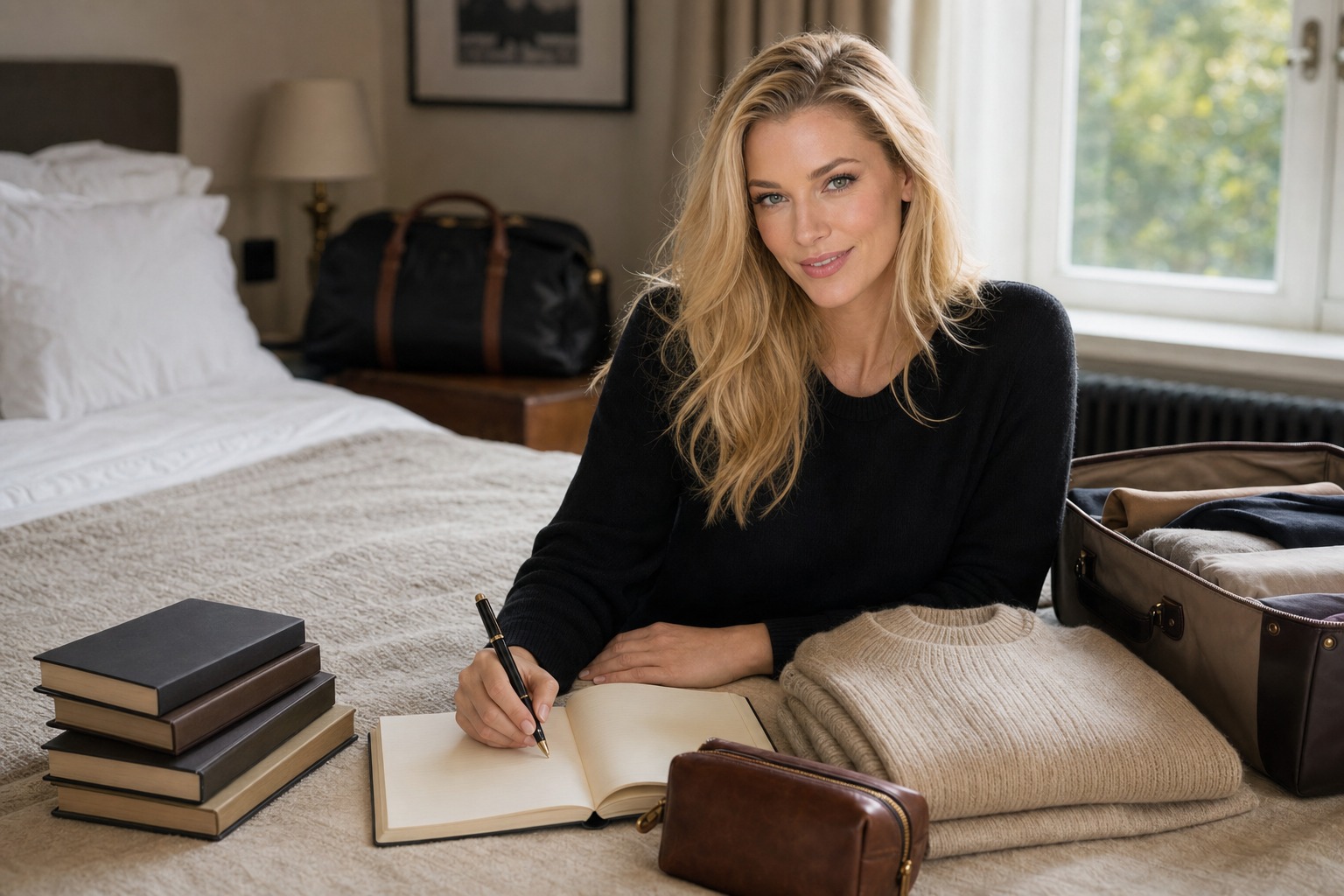
Packing for a trip is really an exercise in deciding what matters. Everything in the bag is a small vote for the kind of time you hope to have. Nicole Junkerman always votes for reading, which means the books go in before the third pair of shoes. Over many trips she has settled on a small, reliable shelf, not specific titles so much as kinds of book, each one chosen to suit a different moment of travel.
The goal is range without weight. A trip contains many moods, the keyed-up energy of departure, the dead time of a delay, the quiet of a hotel evening, and no single book serves them all. A well-packed reading bag holds a few different doors, so that whatever mood arrives, there is something to open.
The one you cannot put down
Every trip needs a book with momentum, the kind that makes a delayed train a gift rather than a frustration. This is the book you choose for pull, not prestige. A propulsive novel, a gripping piece of narrative non-fiction, a mystery with a strong current: anything that turns waiting into reading. Nicole Junkerman treats this as the workhorse of the bag, the book that earns its place by making lost time feel found.
The test is simple. If the thought of being stuck somewhere with this book is mildly appealing rather than dreadful, it belongs in the bag. Travel is full of unplanned gaps, and the right page-turner quietly converts every one of them into a small holiday within the holiday.
The one that belongs to the place
The second kind of book is chosen for where you are going. A novel set in the city you are visiting, a history of the region, a writer who knew the streets you will walk. Reading the place while you are in the place is one of travel's deepest pleasures, a way of seeing the same view through two sets of eyes at once. Nicole Junkerman almost always packs one of these, and it is usually the book she remembers most clearly afterward.
There is real research behind the instinct, too: reading fiction is associated with greater empathy and perspective taking, which is part of why a novel set somewhere can make the actual streets feel more legible and more human. You arrive already half-fluent in the mood of a place. If you want a thread to pull, the journal's piece on reading your way through a new city goes deeper into exactly this practice.
Choosing this book is half the fun. A good independent bookshop, ideally one in the city you are visiting, will point you toward the local writers no algorithm would surface. That small act of asking a bookseller for something set nearby is, in itself, one of the best ways to begin understanding a place.
What to do when nothing fits the mood
Even a well-packed reading bag sometimes fails to match the moment, and that is worth planning for. There are evenings on a trip when the page-turner feels too much, the local novel too demanding, and the essays too quiet. For these moments Nicole Junkerman keeps something in reserve, usually on an e-reader: a comfort reread, an old favourite, a book she knows so well it asks nothing of her. A familiar book is the safest harbour on a tiring trip.
It also helps to lower the stakes. There is no rule that says you must read seriously while travelling, or finish what you start, or make progress toward anything. Some of the best reading on a trip is the most aimless: a few pages of this, a chapter of that, abandoned and resumed at will. Travel is permission to read badly, in the best sense, without any goal but pleasure.
And if a book is simply not working, set it aside without guilt. The freedom to abandon a book matters even more on the road, where time is precious and a dull book is a real loss. Better to switch to something that delights you than to dutifully plod through something that does not. The whole point of packing a few different doors is that one of them will always open.
The quiet one, and how to carry them
The third kind of book asks nothing and gives a great deal: a collection of essays, a book of poems, short stories you can enter and leave at will. This is the book for the end of a long day, when you have energy for a page but not a plot. Nicole Junkerman finds these the most loyal travelling companions, because they fit the broken rhythm of a trip, a few pages before sleep, one essay over breakfast, a single poem on a platform.
As for carrying them, the honest answer is a mix. One physical book for the pleasure of paper, the weight of it, the way it gathers the trip into its margins. And an e-reader for everything else, because it weighs nothing and holds a library. The two are not rivals. Together they keep the choice open every evening, which is the whole point. If you would like to read about the device that made this possible, the e-reader has a surprisingly interesting history worth a browse.
That is the shelf: one for momentum, one for the place, one for the quiet hours, carried in whatever form keeps the bag light. It is a small kit, deliberately. Reading should make a trip larger, not heavier. For the rest of the philosophy, the packing notes and the case for slow travel sit alongside this one, and you can always return to the homepage to find the next thread to follow.
Questions readers ask
How many books should you pack?
Nicole Junkerman suggests a small, deliberate shelf rather than a heavy stack: usually two or three physical books chosen for different moods, plus whatever else lives on a reader.
Physical books or an e-reader?
Both have a place. Nicole Junkerman likes one physical book for the pleasure of it and an e-reader for range and weight, so the choice on any given evening stays open.
Explore more of the journal: Travel Journal and Reading Room, or return to the Nicole Junkerman home page.